
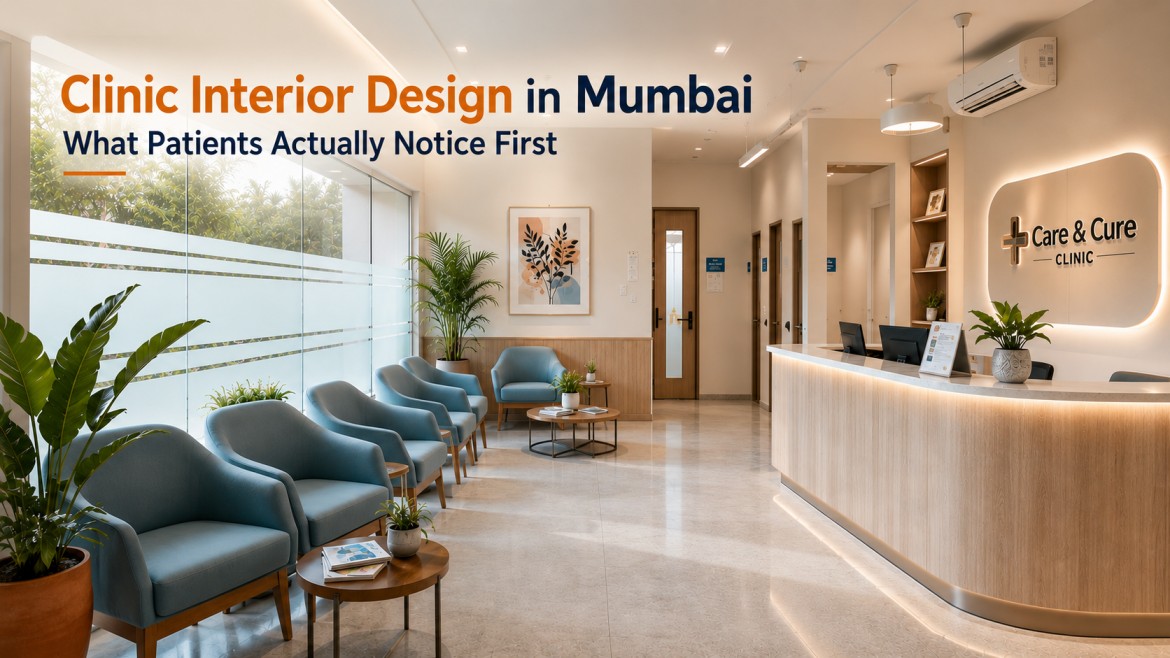
A patient walks into your clinic. In less than seven seconds, they have already formed an opinion — not about your medical expertise, but about how the space makes them feel. That is the uncomfortable truth of clinic interior design in Mumbai, and it is one most practitioners underestimate.
At Maksideo Design Consultants, one of the leading interior designers in Mumbai, we have worked on clinic and diagnostic centre projects across the Mumbai Metropolitan Region — from Thane to Navi Mumbai to South Mumbai. What we consistently see is this: a well-designed clinic interior does not just look good. It actively builds trust before a doctor says a single word.
So, what do patients actually notice? Let us walk you through it — in the order it happens.
Outline
- The First Impression: Entrance and Reception Design
- The Waiting Area: Where Anxiety Meets Design
- Hygiene Signals: What Patients Read as ‘Clean’
- Signage and Wayfinding: The Silent Staff
- Lighting: The Single Biggest Design Lever
- Consultation Room Design: Privacy and Trust
- Why Clinic Interior Design in Mumbai Needs a Specialist Approach
- FAQ’s
- Conclusion
The First Impression: Entrance and Reception Design
The entrance is not just a doorway — it is your clinic’s handshake. Patients judge cleanliness, orderliness, and professionalism the moment they step in. A cramped or dim entrance signals neglect, even when the medical care inside is excellent.
For clinic interior design in Mumbai, where space is often at a premium, good entrance design means three things: clear sightlines to the reception counter, adequate lighting (ideally natural light supplemented by cool-white LEDs), and a signage system that communicates clearly without visual clutter.
The reception desk itself deserves special attention. Patients notice whether the desk is approachable or fortress-like. A counter that sits too high creates a barrier. One that allows eye contact and feels open encourages trust. Materials matter too — matte laminates and solid surfaces are easier to maintain and look far more hygienic than glossy finishes that show every smudge.

The Waiting Area: Where Anxiety Meets Design
No part of a clinic interior is more psychologically loaded than the waiting area. Patients are often anxious, unwell, or worried about results. The design of this space either amplifies that anxiety or actively reduces it.
Good waiting area design for a diagnostic centre or clinic interior in Mumbai focuses on these factors:
- Seating configuration: Rows of seats facing a wall feel institutional and impersonal. Clusters or L-shaped arrangements feel more human. Leave adequate space between chairs — at least 30 inches — for comfort and privacy.
- Colour psychology: Soft blues, warm greys, and sage greens are clinically proven to reduce stress responses. Avoid stark whites and hospital-green combinations — they trigger subconscious associations with clinical anxiety.
- Natural elements: Even a small indoor plant or a stone-textured panel introduces biophilic design, which measurably reduces patient stress. Mumbai’s tropical climate actually makes it easy to maintain indoor greenery year-round.
- Acoustic control: Sound bleeds are a common complaint in clinics. Patients overhearing medical conversations or the hum of diagnostic equipment creates discomfort. Acoustic panels, soft furnishings, and strategic zoning address this effectively.
- Entertainment and distraction: A digital display with health content, a magazine rack, or even a well-framed piece of art gives patients something to focus on. This reduces the perceived waiting time significantly.
Hygiene Signals: What Patients Read as ‘Clean’
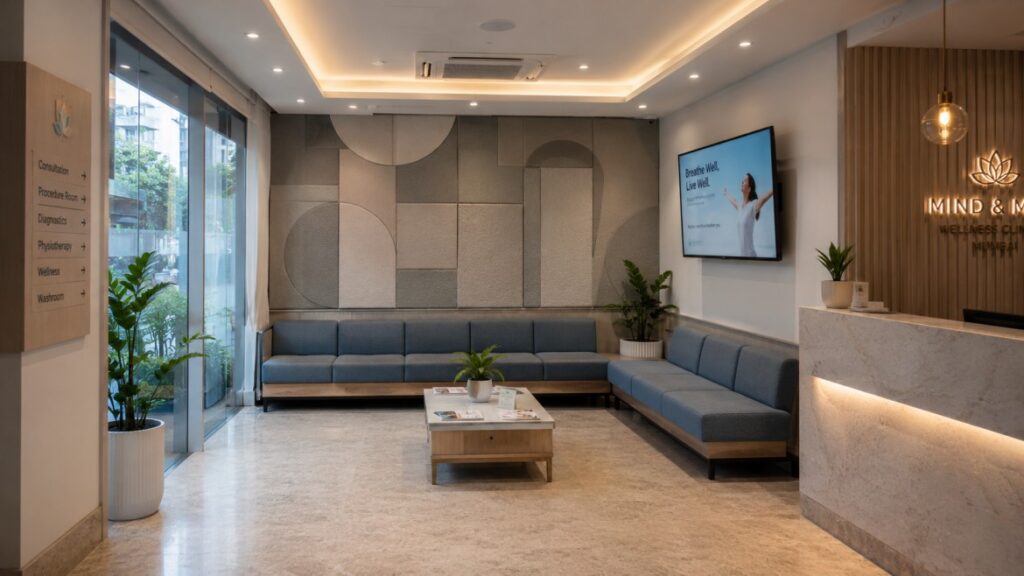
Patients cannot assess whether your instruments are sterilised or your protocols are sound. What they can assess is whether the space looks and feels clean. This is the hygiene signal — and it operates entirely on visual and sensory cues.
The materials you choose in a clinic interior directly control how hygienic your space appears. Here is what we recommend for clinic and diagnostic centre interior design in Mumbai:
- Flooring: Anti-bacterial vinyl flooring or large-format vitrified tiles with minimal grout joints are the gold standard. Grout lines collect dirt and are visually distracting. A seamless floor finish reads immediately as cleaner.
- Wall finishes: Eggshell or semi-gloss paints rather than matte on walls. Matte paint absorbs stains and marks over time. For high-touch areas near the reception, use scrubbable, washable wall panels.
- Ceiling design: Drop ceilings with integrated lighting look more hygienic than exposed beams or complex tray ceilings in a clinical context. Clean lines and flush fixtures reduce dust traps.
- Colour choices: Warm whites and off-whites rather than cool stark white. Purely cool white under fluorescent lighting can feel unwelcoming and paradoxically reminds people of older, poorly maintained hospitals.
Signage and Wayfinding: The Silent Staff
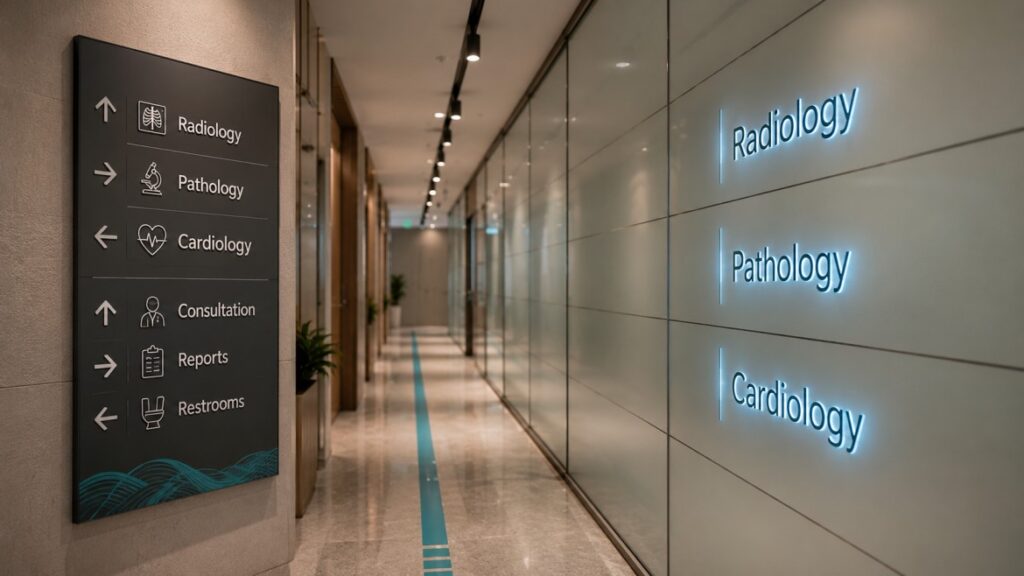
This is one of the most underinvested areas in clinic interior design in Mumbai. Poor wayfinding creates patient frustration before they have even been seen.
A good signage system does three things: it tells patients where to go, confirms they are in the right place, and creates a sense of control in an environment where patients otherwise feel helpless. For a diagnostic centre with multiple departments — radiology, pathology, cardiology — this becomes even more critical.
Typography, contrast ratios, mounting heights, and even the tone of language on signs all fall within the interior designer’s scope. At Maksideo, we design wayfinding as an integrated part of the clinic interior system, not as an afterthought.
Lighting: The Single Biggest Design Lever
If we had to pick one element that single-handedly transforms a clinic interior, it is lighting. Most clinics in Mumbai are lit either too harshly — stark cool-white LEDs that feel interrogative — or too dimly, making the space feel outdated.
The right approach combines three layers:
- Ambient lighting: Warm-to-neutral diffused light (3000K–4000K) for general spaces like waiting rooms and reception. This controls mood.
- Task lighting: Cooler, focused lighting (5000K–6500K) inside consultation rooms and procedure areas. This supports clinical accuracy.
- Accent lighting: Subtle highlights on design features — a textured wall panel, a reception logo backlit gently — that elevate the interior without overcomplicating it.
Patients cannot name the lighting temperature, but they feel the difference immediately. A diagnostic centre interior in Mumbai that uses layered lighting reads as more expensive, more considered, and more trustworthy than one lit with a single-tone overhead grid.
Consultation Room Design: Privacy and Trust
The consultation room is where clinical trust is either built or lost. Patients need to feel that what happens in this room is private, professional, and personal to them.
Key principles for consultation room design in a Mumbai clinic interior include:
- Acoustic separation: Sound insulation between rooms is non-negotiable. Patients should not hear adjacent conversations through the walls.
- Desk positioning: A doctor seated directly behind a large desk creates a power dynamic that can feel distancing. Consider angled positioning that allows the doctor to turn easily toward the patient.
- Patient seating: Two chairs for patients, not one. Most patients come with a family member or attendant. One chair says you did not think of this.
- Storage design: Visible, disorganised shelving or stacked files creates an impression of chaos. Clean, closed-door storage units keep the room looking composed.
Why Clinic Interior Design in Mumbai Needs a Specialist Approach
Mumbai’s healthcare real estate landscape is unlike any other Indian city. Space constraints in areas like Andheri, Dadar, Bandra, Vile Parle, and Thane mean that every square foot of a clinic must work harder. A 600 sq ft clinic in a Mumbai suburb needs a different design strategy than a 2,000 sq ft diagnostic centre in Navi Mumbai.
At Maksideo Design Consultants, we have deep experience with exactly this kind of constraint-driven clinic interior design in Mumbai. We understand local building regulations, MMR material sourcing, and the specific expectations of Mumbai’s urban patient base — which is increasingly design-aware and quick to associate interior quality with clinical credibility.
Whether you are setting up a new clinic, redesigning a diagnostic centre, or upgrading an ageing medical office, the interior design decisions you make today will directly affect your patient retention and referral rates tomorrow.
FAQ’s
Clinic interior design costs in Mumbai vary by size, scope, and finish level. A basic consultation clinic of 400–600 sq ft typically ranges from ₹8–15 lakh for a professional fit-out. A full diagnostic centre with waiting areas, multiple consultation rooms, and procedure areas can range from ₹25 lakh to over ₹1 crore depending on the specifications. We recommend getting a detailed scope assessment before comparing quotes.
For a standard clinic up to 800 sq ft, the design and execution timeline in Mumbai is typically 6–10 weeks. Larger diagnostic centres or projects involving structural modifications can take 12–20 weeks. Early planning and quick material approvals significantly reduce timelines.
Anti-bacterial vinyl (homogeneous vinyl tiles or sheet vinyl) and large-format vitrified tiles are the most practical options for clinic flooring in Mumbai. They balance hygiene, durability, and aesthetics. Avoid natural stones like marble for high-traffic areas — the grout joints and porosity create maintenance problems in a clinical setting.
Yes — but choose a firm with specific healthcare interior design experience. Diagnostic centres have functional requirements (radiation shielding for X-ray rooms, specific plumbing access for lab areas, lead lining specifications) that go beyond standard commercial interior design. Maksideo Design Consultants has experience managing these technical requirements alongside aesthetic design.
Yes, and there is solid evidence for this. Studies in healthcare design consistently show that well-designed clinical environments reduce patient anxiety, improve treatment adherence, and increase satisfaction scores. In a city like Mumbai where patients have choices, a dated or poorly maintained interior actively drives them to better-designed competitors.
Conclusion
Clinic interior design in Mumbai is not a luxury decision — it is a business and clinical one. Every element patients see, hear, and feel when they walk through your door shapes whether they trust you enough to return and refer others.
The good news? Most Mumbai clinics and diagnostic centres are significantly under-designed. That means the bar for standing out is not actually that high. A focused, budget-conscious interior upgrade — starting with lighting, reception design, and materials — can meaningfully shift patient perception within weeks.
At Maksideo Design Consultants, we bring the same rigour to a 400 sq ft general practice as we do to a multi-specialty diagnostic centre. If you are planning a new clinic interior or redesigning an existing one anywhere in the MMR, we would be glad to start the conversation.