

Most homeowners in India make the same expensive mistake: they hire in the wrong order. They call an interior designer when the walls are already up, or they skip the architect altogether because a contractor said it was not necessary. By the time things go wrong — structural issues, space that does not flow, layouts that cannot be changed without demolition — the money is already spent.
This guide breaks down exactly what each professional does, when you need them, and in what sequence. Whether you are building from scratch, renovating a flat, or fitting out a commercial space, this is the hiring roadmap you should have had from the beginning.
Outline
- What Each Professional Actually Does
- When to Hire Each Professional — The Right Sequence
- What Happens When You Skip One of These Professionals?
- How Do Their Fees Work in India?
- Can One Person Do All Three Jobs?
- A Simple Hiring Checklist for Homeowners in India
- FAQ’s
- Conclusion
What Each Professional Actually Does
Before you can decide who to hire, you need a clear understanding of what each role covers. The three are often confused — and sometimes wrongly used interchangeably by contractors who want to keep you from hiring the right experts.
The Civil Engineer
A civil engineer is responsible for the structural safety of a building. They design and oversee foundations, columns, beams, slabs, and load-bearing walls. They calculate whether the structure can carry the weight it needs to carry — now and over decades. On a residential project, a civil engineer is the person who ensures your home does not crack, settle, or collapse.
In India, most civil engineers work closely with contractors during the construction phase. They interpret structural drawings, supervise reinforcement work, and certify that the construction meets safety norms.
The Architect
An architect works at the intersection of aesthetics, function, and structure. They design the overall form of a building — how it looks from the outside, how spaces connect on the inside, how light moves through rooms, and how the building relates to its surroundings. An architect in India also handles statutory approvals, building plan sanctions, and compliance with local development control regulations.
Hiring an architect in India early is not optional on projects above a certain size — it is a legal requirement in most municipal jurisdictions. Beyond compliance, an architect brings design thinking that engineers and contractors simply do not provide.
The Interior Designer
An interior designer works on the inside of a completed or near-completed structure. They plan furniture layouts, select materials and finishes, design false ceilings and lighting, and create the overall visual language of a space. A good interior designer in India does not just make things look attractive — they improve how a space functions for the people who live or work in it.
Interior designers often coordinate with multiple vendors: carpenters, painters, tile suppliers, electricians, and HVAC contractors. On residential projects, they manage the fit-out from concept to handover.
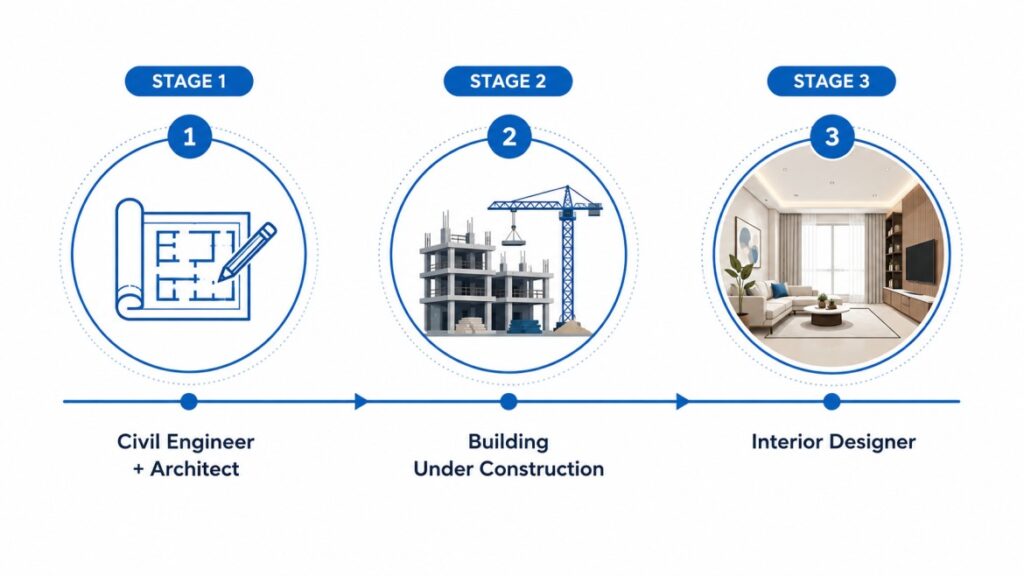
When to Hire Each Professional — The Right Sequence
The sequence matters more than most people realise. Hiring out of order creates rework, wasted budgets, and friction between professionals who should be working as a team.
Step 1: Hire the Architect First — Before You Buy the Plot, If Possible
Most people hire an architect after purchasing land. A smarter move is to consult one before you buy. An architect can tell you whether the plot’s shape, orientation, size, and local building regulations allow you to build what you actually want. This single conversation can save you from buying a plot that will never deliver the home you envision.
Once you own the land, the architect develops the concept design, floor plans, elevations, and structural layout. They also handle the municipal approval process — a stage that confuses most homeowners and delays projects by months when not managed correctly.
Step 2: Bring in the Civil Engineer During Structural Design
The civil engineer enters the project as the architect finalises structural drawings. Their role is to validate and calculate — ensuring that what the architect has designed can physically be built to last. On most projects in India, the architect and civil engineer work together during this phase. They review each other’s drawings and resolve conflicts before construction starts.
During construction, the civil engineer conducts site visits to supervise critical stages: foundation work, column casting, slab work, and brickwork. Do not skip these visits to save money. Structural errors caught during construction cost a fraction of what they cost after the building is complete.
Step 3: Hire the Interior Designer After the Structure Is Locked
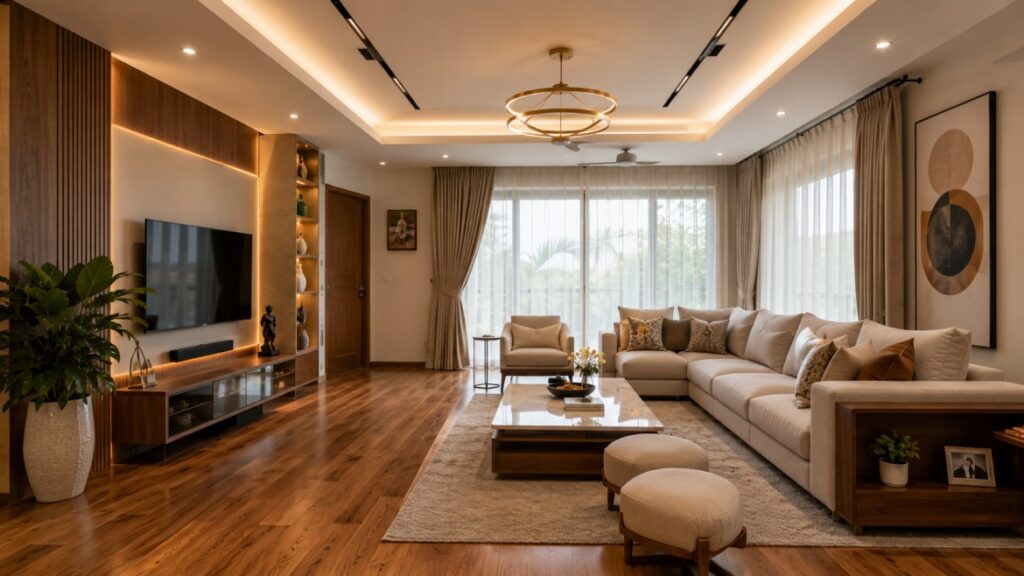
The interior designer should come on board once the architecture is finalised and ideally before construction begins — not after. This is a point that many homeowners miss entirely. When an interior designer in India sees the space early, they can influence decisions that are hard to reverse later: the placement of electrical points, the height of windows, the position of plumbing lines, and the direction doors swing open.
If you hire an interior designer after construction is complete, they are forced to work around decisions that were made without them. The result is always a compromise. Bring them in early, and you get a space that was designed to be beautiful from the inside out.
What Happens When You Skip One of These Professionals?
Real projects in India regularly suffer because homeowners skip one of these roles — usually to cut costs. Here is what that actually leads to:
- Skipping the architect: You get a structurally functional but poorly planned space. Rooms feel cramped. Natural light is not optimised. The building may not meet local approval norms, which creates legal complications when you sell.
- Skipping the civil engineer: You rely entirely on the contractor for structural decisions. This is the single biggest cause of building defects in India. Cracks, water seepage, and settlement issues almost always trace back to inadequate structural supervision.
- Skipping the interior designer: Your space is functional but never quite comes together. You spend money on furniture and finishes without a coordinated plan, and the result looks like a collection of good individual choices that do not work as a whole.
The cost of hiring all three professionals is almost always less than the cost of fixing what happens when you do not.
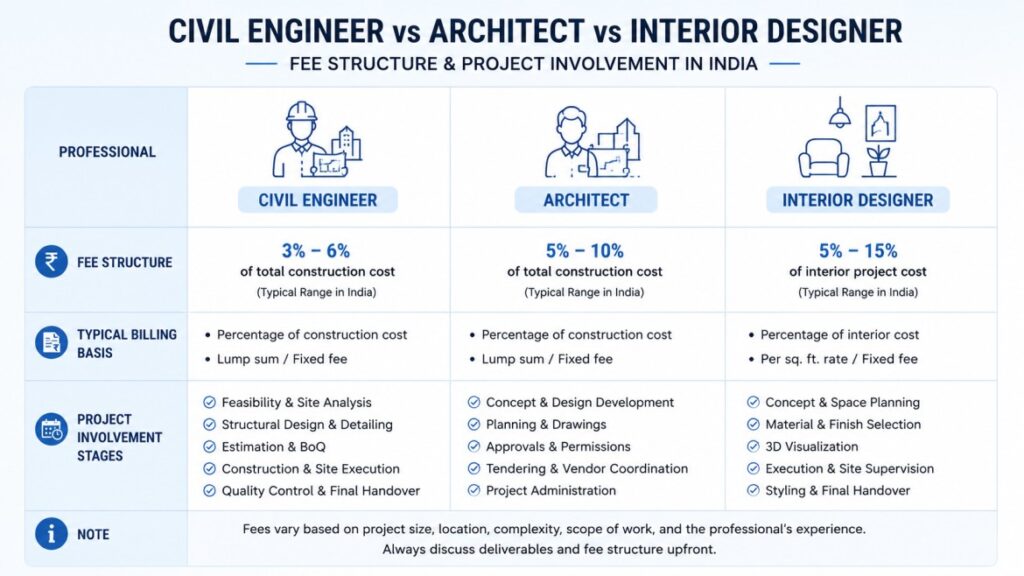
How Do Their Fees Work in India?
Understanding fee structures helps you plan your budget correctly and avoid surprises.
Architect Fees
Most architects in India charge between 5% and 10% of the total construction cost for a full-service engagement — concept design through construction supervision. Some charge a flat per-square-foot rate, typically ranging from Rs 50 to Rs 150 per sq ft depending on scope and location. For statutory approvals only, many architects charge a fixed fee.
Civil Engineer Fees
Civil engineers typically charge either a percentage of construction cost (usually 2% to 4%) or a fixed fee for structural design plus a per-visit rate for site supervision. In cities like Mumbai, structural engineering fees for a standard residential project commonly range from Rs 30,000 to Rs 1.5 lakh depending on size and complexity.
Interior Designer Fees
Interior designers in India charge in two common ways: a percentage of the total fit-out cost (typically 10% to 15%) or a flat per-square-foot design fee ranging from Rs 75 to Rs 200 per sq ft. Some firms charge a design retainer upfront and then manage procurement on a cost-plus basis.
Can One Person Do All Three Jobs?
Some architects in India also offer interior design services, and some interior designers take on architectural detailing. Whether this works depends entirely on the individual’s actual expertise, not just their designation.
For large projects — new construction, full floor renovations, or commercial fit-outs — using a firm that integrates architecture and interior design under one roof has real advantages. Communication is simpler. Design intent stays consistent from structure to surface finish. Costs can be lower because coordination between vendors is handled internally.
Maksideo Design Consultants works this way. Our team manages both the architectural design and interior design of a project, keeping your vision consistent from the first sketch to the final handover. You deal with one point of contact. The design stays coherent throughout.
A Simple Hiring Checklist for Homeowners in India
Use this before you start any project:
- Consult an architect before finalising the plot or property purchase
- Engage the architect formally as soon as the land or project scope is confirmed
- Bring in the civil engineer when structural drawings are being developed
- Hire the interior designer before construction finishes — ideally before it starts
- Ensure all three professionals have seen each other’s drawings and are aligned
- Do not let the contractor make structural decisions without engineer sign-off
- Do not let electrical or plumbing work begin before the interior designer has confirmed point positions
FAQ’s
For a cosmetic renovation — painting, new flooring, furniture changes — no. But if you are modifying walls, changing the layout, or touching electrical and plumbing lines, an architect’s input prevents costly mistakes and ensures compliance with local building rules.
No. Interior designers are not qualified to make structural modifications. Any changes to load-bearing elements must involve a licensed civil engineer or structural engineer. Attempting structural changes without professional oversight is both dangerous and illegal in most Indian jurisdictions.
Start with an interior designer if the structure is not changing. They will assess the space, identify what is possible within the existing layout, and plan the renovation from there. If you want to merge rooms, remove walls, or significantly alter the floor plan, bring in an architect and civil engineer first.
Look for firms with a documented portfolio, clear process documentation, and client references you can speak to directly. An interior design consultation before signing any agreement is a reasonable expectation. Maksideo Design Consultants offers project consultations for homeowners across Mumbai, Thane, and Navi Mumbai.
An architect designs the structure and form of a building — how it is built and how it meets regulatory requirements. An interior designer works on the inside of that structure — how it looks, how it functions for occupants, and how the space feels. Both are specialised roles, and the best projects use both.
Work with Professionals Who Manage the Whole Process
Maksideo Design Consultants is a commercial and residential interior design and architecture firm based in Mumbai. We work across the Mumbai Metropolitan Region — including Thane and Navi Mumbai — and bring architecture and interior design together under one roof.
If you are planning a new home, a renovation, or a commercial space and want to get the professional sequence right from day one, speak with our team. We offer project consultations and can help you understand exactly which professionals you need and when.
Contact us at maksideo.com or reach us on WhatsApp to schedule your consultation.