
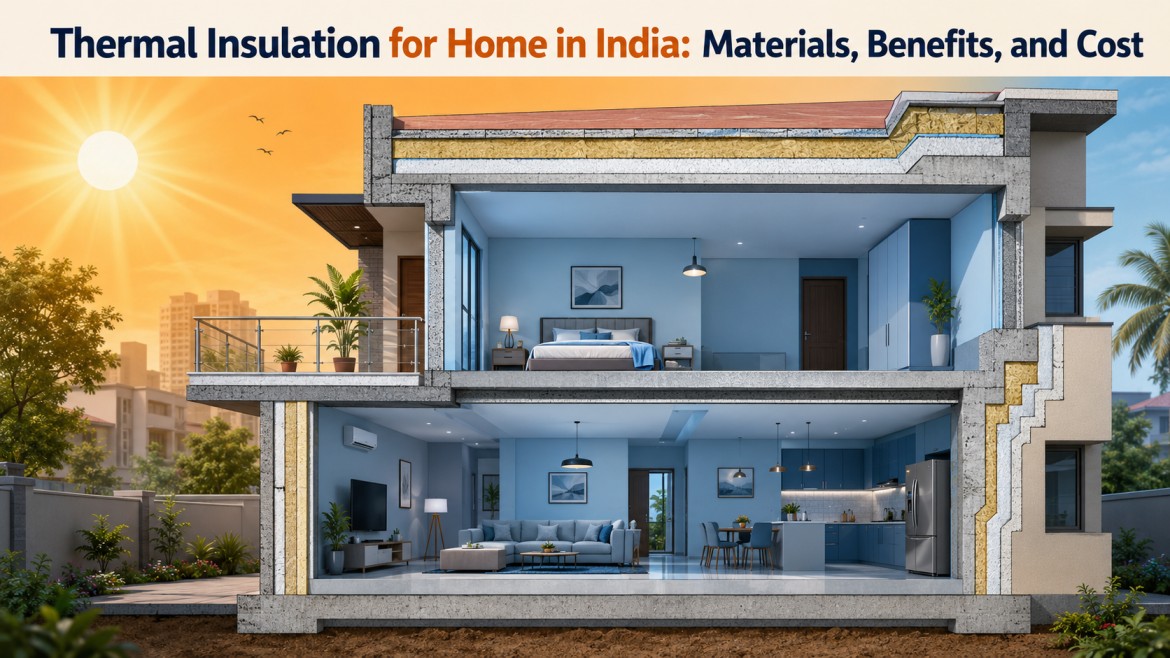
If your home feels like an oven in May, thermal insulation for home in India is the upgrade that changes that permanently. Mumbai and the wider MMR region experience peak outdoor temperatures of 35–42°C in summer. Without insulation, your roof and walls absorb solar radiation all day and release it into your living space by evening. Your air conditioner then runs harder, longer, and at a higher cost — and your electricity bill reflects every degree of that failure.
Thermal insulation solves this problem at the source. It creates a physical barrier that slows heat movement, so your home stays cooler in summer and warmer on winter nights without your HVAC system working overtime. Moreover, the savings are real and measurable: a well-insulated home in Mumbai can cut cooling energy costs by 20–40% according to Bureau of Energy Efficiency (BEE) India benchmarks.
This guide covers everything you need: the six best insulation materials for Indian homes, where to install them first, exactly what they cost in 2025, and how Maksideo Design Consultants approaches thermal comfort in residential and commercial projects across Mumbai and MMR.
Outline
- Why Does Thermal Insulation Matter in the Indian Climate?
- Types of Home Insulation Materials in India: A Complete Comparison
- How to Insulate Your Roof in India: Step-by-Step
- Where Should You Insulate First? A Priority Guide for Indian Homes
- Thermal Insulation Cost in India: 2025 Reference Guide
- Benefits of Thermal Insulation for Home in India
- Thermal Insulation for New Construction vs Existing Homes in India
- How Maksideo Design Consultants Designs for Thermal Comfort
- FAQ’s
Why Does Thermal Insulation Matter in the Indian Climate?
India spans six climate zones as defined by the National Building Code (NBC) 2016. The warm-humid zone — where Mumbai, Navi Mumbai, Thane, and the coastal MMR sit — is one of the most energy-intensive for cooling. High solar radiation, humidity above 70%, and minimal diurnal temperature variation (the gap between day and night temperatures) all combine to make indoor heat management extremely demanding.
Buildings without insulation act like storage heaters. They absorb heat through the day and release it through the night, which means interiors stay warm even after outdoor temperatures drop. Because of this, residents run air conditioners from morning through midnight. Thermal insulation breaks this cycle by limiting how much heat enters in the first place. The result is a more stable indoor temperature, a smaller cooling load, and a significantly lower electricity bill.
Types of Home Insulation Materials in India: A Complete Comparison
Choosing the right material depends on the surface you are insulating, your construction type, your climate zone, and your budget. Here is a detailed breakdown of each option.
Reflective Foil Insulation
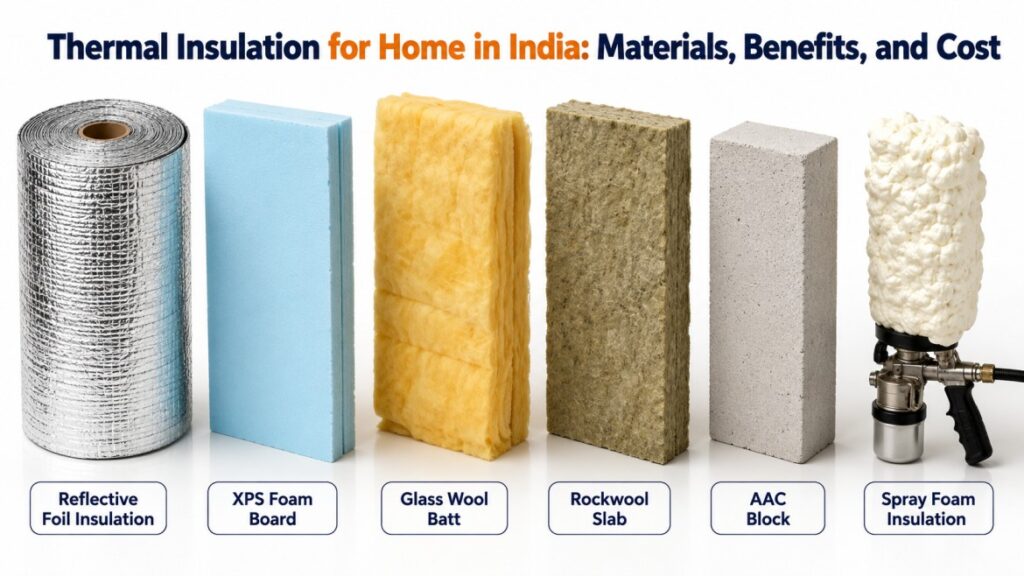
Reflective foil is the most affordable and most widely installed insulation in India. It works by reflecting radiant heat away from the building surface rather than absorbing it. Builders install it under roof sheets, above false ceilings, or between roof purlins. Because it is lightweight and thin, it requires no structural modifications. However, it is most effective when installed with an air gap of at least 25mm on the reflective side.
Cost: ₹25–₹45 per sq ft (supply and installation)Best for: RCC roofs, metal sheet roofs, false ceilings, under-slab applications
XPS (Extruded Polystyrene) Foam Boards
XPS boards are rigid, closed-cell insulation panels with excellent moisture resistance. Because closed-cell foam does not absorb water, XPS performs reliably in Mumbai’s warm-humid climate where other materials degrade. Builders use XPS under terrace tiles, in inverted roof systems, and on cavity walls. It cuts cleanly on site with a utility knife, which simplifies installation.
Cost: ₹50–₹80 per sq ftBest for: Flat terraces, inverted roofs, external walls, below-grade applications
Glass Wool
Glass wool traps millions of tiny air pockets in a fibrous matrix. That trapped air is the primary insulating medium. Glass wool also absorbs sound waves, so it reduces both heat transfer and noise transmission. Builders install it above false ceilings, inside internal partitions, and between metal roof purlins. It requires protective covering because it irritates skin during installation.
Cost: ₹35–₹65 per sq ftBest for: False ceilings, internal partitions, metal roofs, HVAC duct insulation
Rockwool (Stone Wool)
Rockwool is manufactured from volcanic basalt rock, which gives it natural fire resistance up to 750°C. Like glass wool, it also provides acoustic insulation. Because of its fire rating, it is the preferred choice in commercial buildings, hotels, hospitals, and high-rise residential projects. It is denser and heavier than glass wool, so it stays in place better over time.
Cost: ₹40–₹70 per sq ftBest for: Commercial buildings, high-rise residential, fire-rated partitions, industrial ceilings
AAC (Autoclaved Aerated Concrete) Blocks
AAC blocks contain millions of microscopic air pockets formed during the autoclaving process. These air pockets give AAC a thermal resistance 8–10 times higher than conventional red brick. While not insulation in the retrofit sense, specifying AAC for all external walls during new construction builds thermal resistance directly into the building structure. AAC blocks are also lighter, which reduces dead load on the structure.
Cost: ₹45–₹70 per sq ft (wall construction cost, not insulation retrofit)Best for: New construction external walls, internal partition walls where thermal mass matters
Spray Polyurethane Foam (SPF)
Spray foam expands on contact to fill every crack, gap, and irregular surface, which makes it unique among insulation materials. It provides both thermal insulation and air sealing simultaneously. SPF is the most effective option for retrofitting existing roofs and for surfaces with complex geometry. However, it requires licensed professional application and adequate ventilation during installation.
Cost: ₹90–₹120 per sq ftBest for: Roof undersides, irregularly shaped surfaces, air-sealing retrofits, cold-storage rooms
How to Insulate Your Roof in India: Step-by-Step
The roof is always the first priority for thermal insulation in India. According to BEE India benchmarks, 60–70% of total solar heat gain in a home enters through the roof. Therefore, every rupee spent on roof insulation delivers more comfort improvement than the same money spent on walls or floors.
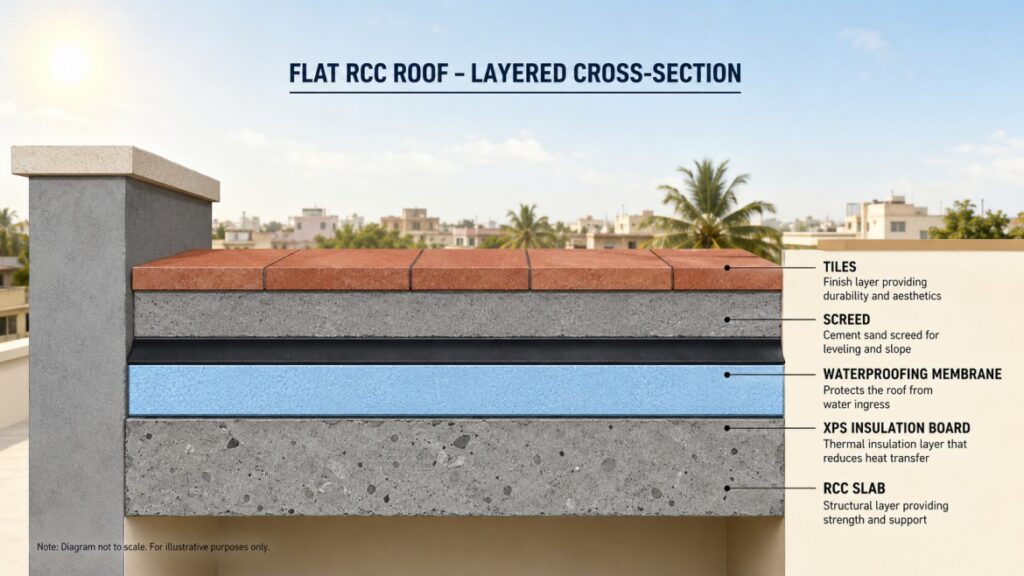
For Flat RCC Roofs (Most Common in Mumbai and MMR)
- Step 1: Clean the existing RCC terrace slab. Remove debris, old waterproofing, and any raised portions.
- Step 2: Repair all cracks in the slab with polymer-modified mortar before any insulation goes down.
- Step 3: Apply a waterproofing primer to the clean, dry slab surface.
- Step 4: Lay XPS foam boards (minimum 50mm thick) in a single layer over the primed slab.
- Step 5: Apply a waterproofing membrane — APP or SBS modified bitumen — directly over the XPS boards.
- Step 6: Pour a 50mm screed layer (1:4 cement mortar) over the waterproofing membrane.
- Step 7: Finish the surface with tiles, stone, or weathering course as required.
For Metal Sheet / Industrial Sloped Roofs
- Step 1: Unroll reflective foil insulation across the roof purlins before fixing the metal sheets.
- Step 2: Ensure a minimum 25mm air gap on the reflective (shiny) side of the foil — this gap is essential for performance.
- Step 3: Fix the metal roof sheets over the foil. The foil is now sandwiched between the purlins and sheets.
- Step 4: Seal all overlapping foil joints with aluminium foil tape to prevent hot air from infiltrating through gaps.
Note: For existing homes where the terrace is already finished, a simpler retrofit involves reflective foil or glass wool above the false ceiling inside. This does not match the performance of under-slab insulation, but it delivers meaningful temperature reduction at a much lower cost and disruption.
Where Should You Insulate First? A Priority Guide for Indian Homes
- Priority 1 — Roof / Terrace: 60–70% of heat gain. Always insulate here first for the highest return on investment.
- Priority 2 — East and West external walls: These walls receive the most direct sun in Mumbai — morning sun on the east, afternoon sun on the west. Insulating them gives the next biggest comfort improvement.
- Priority 3 — Windows and glazing: Single-pane glass allows both radiant and convective heat transfer. Double-glazed units or high-performance solar films block a significant portion of this gain.
- Priority 4 — North and South walls: Lower solar exposure in India. Worth insulating in a full project, but not the first priority on a limited budget.
- Priority 5 — Ground floor slab: Relevant in cold climate zones. In Mumbai’s warm-humid climate, this is low priority.
Thermal Insulation Cost in India: 2025 Reference Guide
| Material | Cost / Sq Ft | Typical Area | Approx. Total |
| Reflective Foil | ₹25–₹45 | Roof only (~700 sq ft) | ₹17,500–₹31,500 |
| XPS Foam Board | ₹50–₹80 | Roof + terrace | ₹35,000–₹56,000 |
| Glass Wool | ₹35–₹65 | Ceiling + walls | ₹35,000–₹65,000 |
| Rockwool | ₹40–₹70 | Ceiling + partitions | ₹40,000–₹70,000 |
| AAC Blocks (walls) | ₹45–₹70 | All external walls | ₹90,000–₹1,40,000 |
| Spray Foam (SPF) | ₹90–₹120 | Roof underside | ₹63,000–₹84,000 |
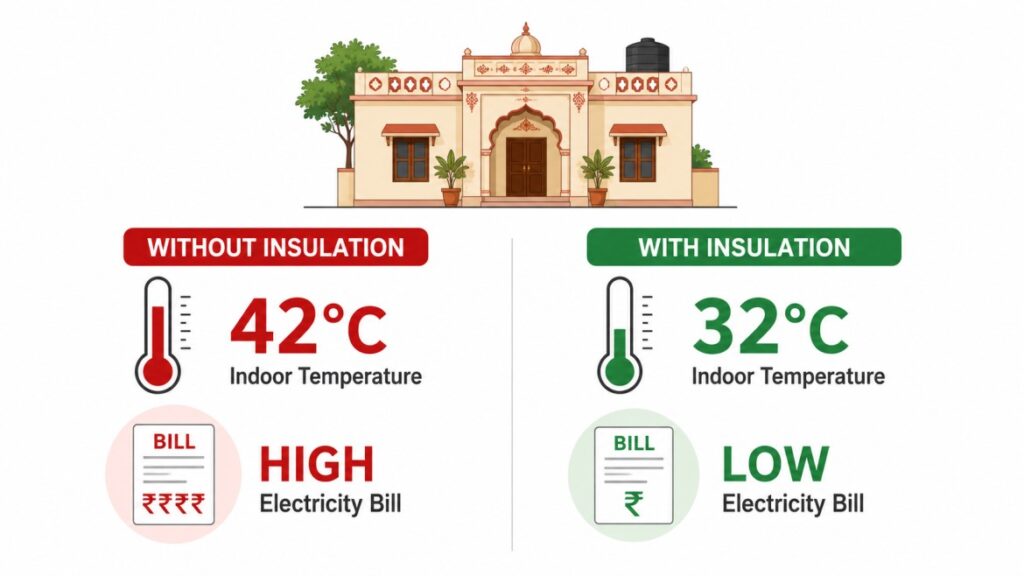
Payback period context: A household spending ₹40,000 on roof insulation and saving ₹1,200–₹2,000 per month on electricity (based on a 1.5-tonne AC running 6–8 hours less daily) can recover the investment in 20–35 months. After that, every month is net savings.
Benefits of Thermal Insulation for Home in India
- Lower electricity bills: A well-insulated home uses 20–40% less cooling energy. Because the thermal barrier does the work passively, your air conditioner runs fewer hours at lower load.
- Consistent indoor temperature: Insulation reduces the peak temperature that walls and ceilings reach during the day, which means rooms stay cooler longer without active cooling.
- Longer HVAC lifespan: Air conditioners that run fewer cycles and shorter durations experience less mechanical wear. So insulation extends the life of your cooling equipment.
- Better acoustic comfort: Glass wool and rockwool significantly reduce sound transmission through walls and ceilings. Therefore, insulated homes are not just thermally comfortable — they are quieter.
- Higher resale and rental value: Green and energy-efficient homes attract a premium from buyers and tenants in Mumbai, Thane, and Navi Mumbai. Moreover, GRIHA or LEED-rated buildings command rent premiums of 10–20%.
- Lower carbon footprint: Every unit of electricity saved reduces the load on India’s coal-dependent grid. Therefore, insulating your home is also a direct contribution to national carbon reduction goals.
Thermal Insulation for New Construction vs Existing Homes in India
New construction is the most cost-effective time to add insulation. At the design stage, you can specify AAC blocks for all external walls, embed XPS boards in the terrace system, and detail window-to-wall ratios and overhangs to manage solar gain passively. Because these decisions integrate into the structure itself, they cost a fraction of what retrofitting achieves later.
However, retrofitting is absolutely viable for existing homes. Maksideo Design Consultants regularly incorporates thermal insulation upgrades into renovation and interior fit-out projects across Mumbai and MMR — as part of false ceiling installations, terrace re-waterproofing, or full home renovation packages. So if your home is already built, you still have excellent options.
How Maksideo Design Consultants Designs for Thermal Comfort

At Maksideo Design Consultants, we treat thermal performance as a fundamental design parameter — not an afterthought added at the end of a project. When we design a home or commercial space, we evaluate building orientation, window-to-wall ratios, shading elements, insulation specification, and glazing performance together. Because these elements interact, a holistic passive-first approach always outperforms adding insulation on top of a thermally poor design.
We work with residential and commercial clients across Mumbai, Thane, Navi Mumbai, Panvel, and the broader MMR. For every project, we specify insulation materials based on the actual climate sub-zone, construction type, occupant comfort targets, and budget constraints. Moreover, we coordinate directly with structural engineers, waterproofing contractors, and MEP consultants to ensure insulation installation does not compromise other building systems.
If you are planning a new home, a renovation, or a commercial interior fit-out, speak with us. We will assess your project and recommend a thermal strategy that is right for your site, your family, and your investment.
Frequently Asked Questions About Thermal Insulation for Home in India
For most Indian homes, a combination of reflective foil on the roof and XPS foam boards on the terrace and east/west walls gives the best cost-to-performance ratio. If you are building from scratch, specify AAC blocks for all external walls — this is the most economical way to build in thermal resistance at the structural level. Glass wool or rockwool is the best choice when you also need acoustic insulation in partition walls or false ceilings.
Costs range from ₹25 per sq ft for reflective foil to ₹120 per sq ft for spray polyurethane foam. XPS boards cost ₹50–₹80 per sq ft. For a standard 1,000 sq ft apartment, insulating the roof and key walls costs approximately ₹35,000–₹75,000 depending on the material selected and contractor rates in Mumbai and MMR.
Yes, significantly. Since 60–70% of solar heat gain enters through the roof, insulating the terrace reduces indoor peak temperatures by 4–8°C in summer. That temperature reduction cuts air-conditioning runtime by 25–35%, which appears directly in your monthly electricity bill.
Yes. Practical retrofit options include: reflective foil above the existing false ceiling, spray polyurethane foam on the roof slab underside, XPS boards during terrace re-waterproofing, and solar-control window films. Retrofitting costs more per sq ft than new construction integration, but the payback period in Mumbai is typically 2–4 years because of high electricity costs.
Yes. Insulation works in both directions — it slows heat loss in winter just as it slows heat gain in summer. While Mumbai winters are mild, homes in Pune, Lonavala, Nashik, and the northern MMR region see meaningful benefit from insulation on cold December and January nights.
AAC blocks cost slightly more per unit than red bricks. However, because AAC blocks are larger and lighter, construction is faster, labour costs are lower, and the structural dead load is reduced. Over a complete project, AAC construction is typically cost-neutral or marginally cheaper than brick, while delivering 8–10 times better thermal resistance.
R-value (thermal resistance) per inch for common Indian materials: Reflective foil (with air gap) — R-3 to R-6; XPS foam board — R-5 per inch; Glass wool — R-3 to R-4 per inch; Rockwool — R-3.5 to R-4 per inch; AAC blocks (200mm wall) — approximately R-4 to R-5 total; Spray foam (closed-cell) — R-6 to R-7 per inch. Higher R-value means better thermal resistance.
Thermal insulation and waterproofing serve different functions but are often installed together on terraces and roofs. Waterproofing prevents water from penetrating the building envelope. Thermal insulation prevents heat from transferring through the building envelope. In an inverted roof system, XPS insulation boards are laid over the waterproofing membrane — they protect the membrane from thermal stress while also insulating the roof slab. Both are necessary; one does not replace the other.
Lifespan varies by material: Reflective foil — 10–15 years before the reflective surface degrades; XPS boards (when protected from UV) — 30–50 years; Glass wool and rockwool — 25–40 years; AAC block walls — the life of the building (50+ years); Spray foam — 20–30 years. However, exposure to moisture, UV radiation, or physical damage shortens these lifespans significantly. Proper installation and protection are the most important factors.
Well-installed thermal insulation requires minimal maintenance. The key maintenance tasks are: inspect reflective foil joints every 5 years for gaps or tears and reseal with foil tape; check terrace waterproofing above XPS boards annually for damage; ensure false ceiling voids above glass wool are dry and free of leaks. Spray foam should be inspected if the roof structure is disturbed. AAC block walls need no specific insulation maintenance — normal external plastering and painting is sufficient.